
By Nicole Hellthaler, Executive Director and PYP Facilitator
For decades, Prison Yoga Project has worked to make yoga and mindfulness accessible to people impacted by incarceration. Today, we are taking another step toward helping more people bring these practices into prisons, jails, and communities impacted by trauma.
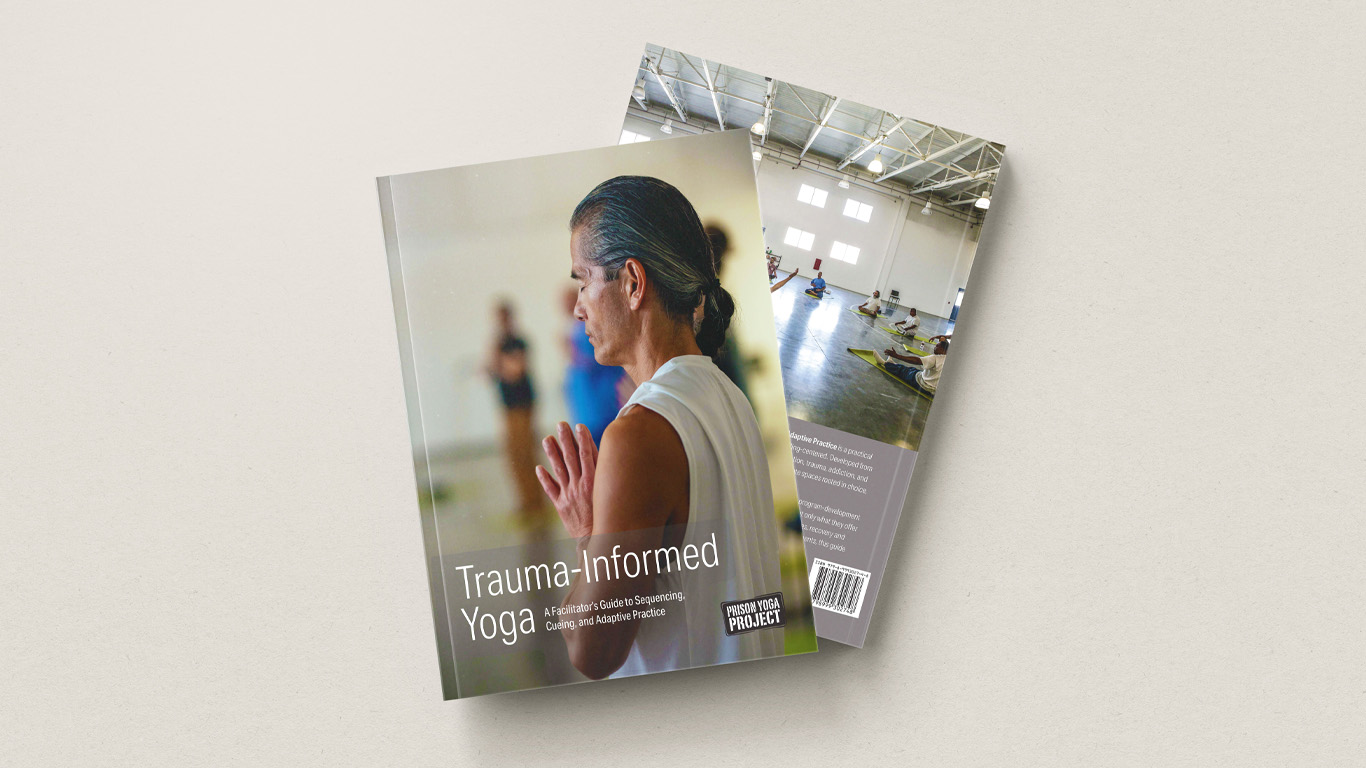
We are excited to announce the release of our newest publication, Trauma-Informed Yoga: A Facilitator’s Guide to Sequencing, Cueing, and Adaptive Practice.
Created by PYP Training Director Jen Lindgren, the guide brings together years of experience teaching, training, adapting practices, and preparing facilitators to work in correctional and other trauma-impacted settings. It offers practical support for building trauma-informed practices, including guidance on sequencing, cueing, adaptation, choice, and creating opportunities for agency.
And last month, nearly 50 people in Brooklyn became the first PYP trainees to put it into practice together.
For the first time in nearly seven years, Prison Yoga Project hosted an in-person training in the United States.
And it felt so good to be back together.
Putting the Guide Into Practice
Nearly 50 people gathered with us at the Sharanam Institute for our Trauma-Informed Yoga Facilitation Intensive. They came from Brooklyn, upstate New York, and beyond, bringing an incredible range of professional and personal experience.
There were yoga teachers, psychologists, psychiatrists, retired attorneys, correctional professionals, people already teaching yoga inside prisons and jails, and people just beginning to imagine how they might bring these practices into their communities.
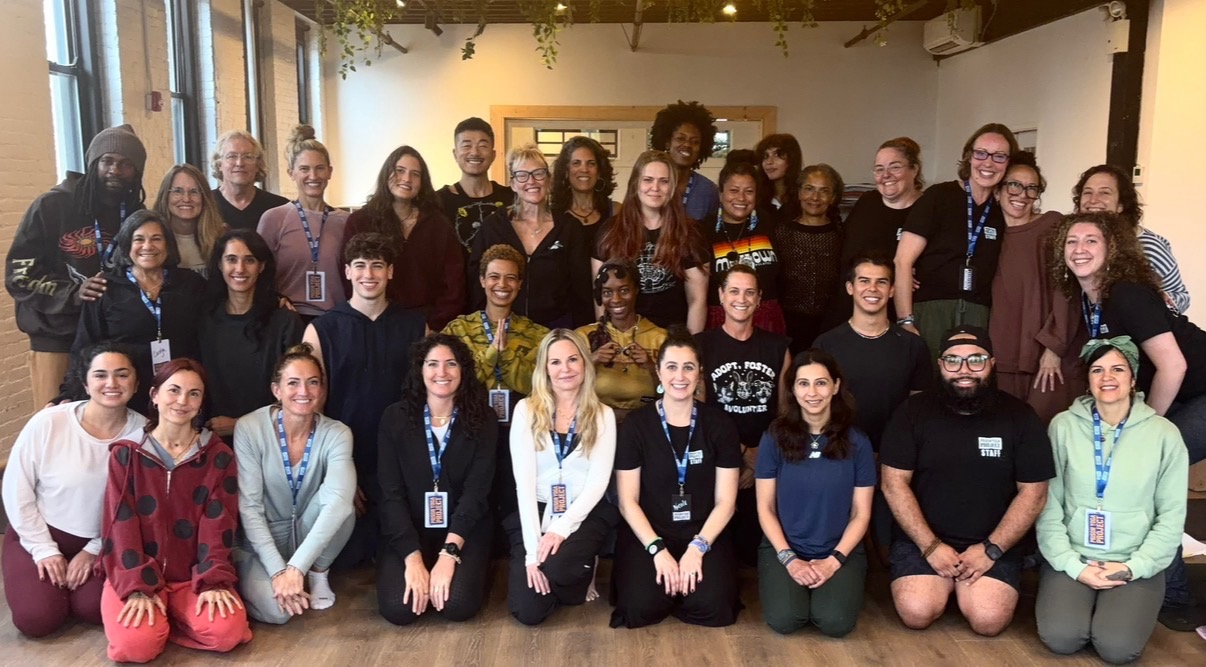
2026 Brooklyn, New York – Trauma-Informed Yoga Intensive Cohort
Throughout the weekend, the new sequencing guide was not simply something sitting in everyone’s training bag. We used it to anchor our discussion, teaching, and learning.
We alternated between discussion and Q&A, practices led by PYP facilitators, working with sequences from the guide, and practicum sessions where trainees had the opportunity to practice facilitating themselves.
We modeled classes designed for both incarcerated adults and young people, which gave our team an opportunity to have a little fun, too. At one point, several staff members enthusiastically took on the role of teenagers while I demonstrated how a facilitator might compassionately redirect challenging behavior without creating shame or escalating the situation.
There was laughter, but there was also a serious purpose behind it.
Trauma-informed facilitation is about much more than choosing safe yoga poses. It is about how we enter a room, how we communicate, how we respond when something unexpected happens, and how we create opportunities for choice and agency.
Those skills are difficult to learn from a slide deck. They need to be practiced.
Our hope is that this guide helps people continue that practice long after a PYP training ends.
Imagining Where These Practices Can Go Next
Some of my favorite conversations in Brooklyn were about what people hoped to do with what they were learning.
Participants talked about bringing trauma-informed yoga and mindfulness to young women, people experiencing homelessness in Brooklyn, incarcerated populations in prisons we have not yet reached, and other communities that often have the least access to practices that support self-regulation, connection, and healing.
This is one of my favorite things about training.
We are not simply teaching people how to facilitate yoga. We are creating space for people to imagine where these tools are needed and how they might responsibly bring them there.
That is also part of why creating resources like this new guide matters.
PYP staff will never be able to personally walk into every prison, jail, juvenile facility, reentry program, or community where these practices could be useful. But we can share what we have learned. We can train others. We can create tools that help facilitators feel more prepared. And we can build a community of people committed to offering these practices with compassion, humility, and respect for the people they serve.
Brooklyn gave us a glimpse of what that can look like.
The Team Behind the Work
Our team started arriving in Brooklyn on Wednesday and Thursday. We spent Thursday and much of Friday working together in person.
For many people, a few days together at the office might not sound particularly exciting. For our fully remote team, it is magic!
We did all the things we normally do from our respective homes across the country: answered emails, worked on grants, wrote newsletters, led our virtual 200-hour Yoga Teacher Training, planned programs, and solved the countless little problems that make a nonprofit run.
But this time, we were sitting next to each other.
We also prepared for the weekend, including assembling training materials and swag bags with copies of our new sequencing guide tucked inside.
On Friday evening, we opened the doors for a casual meet-and-greet. Trainees could see the space where we would spend the weekend, meet our staff, pick up their materials, and begin getting to know one another.
That part matters to us.
Community and relationships are at the heart of PYP’s work, and our trainings should reflect that from the moment someone walks through the door.
For our first U.S. in-person training in nearly seven years, we brought a big team to Brooklyn. I want to take a moment to brag about them.
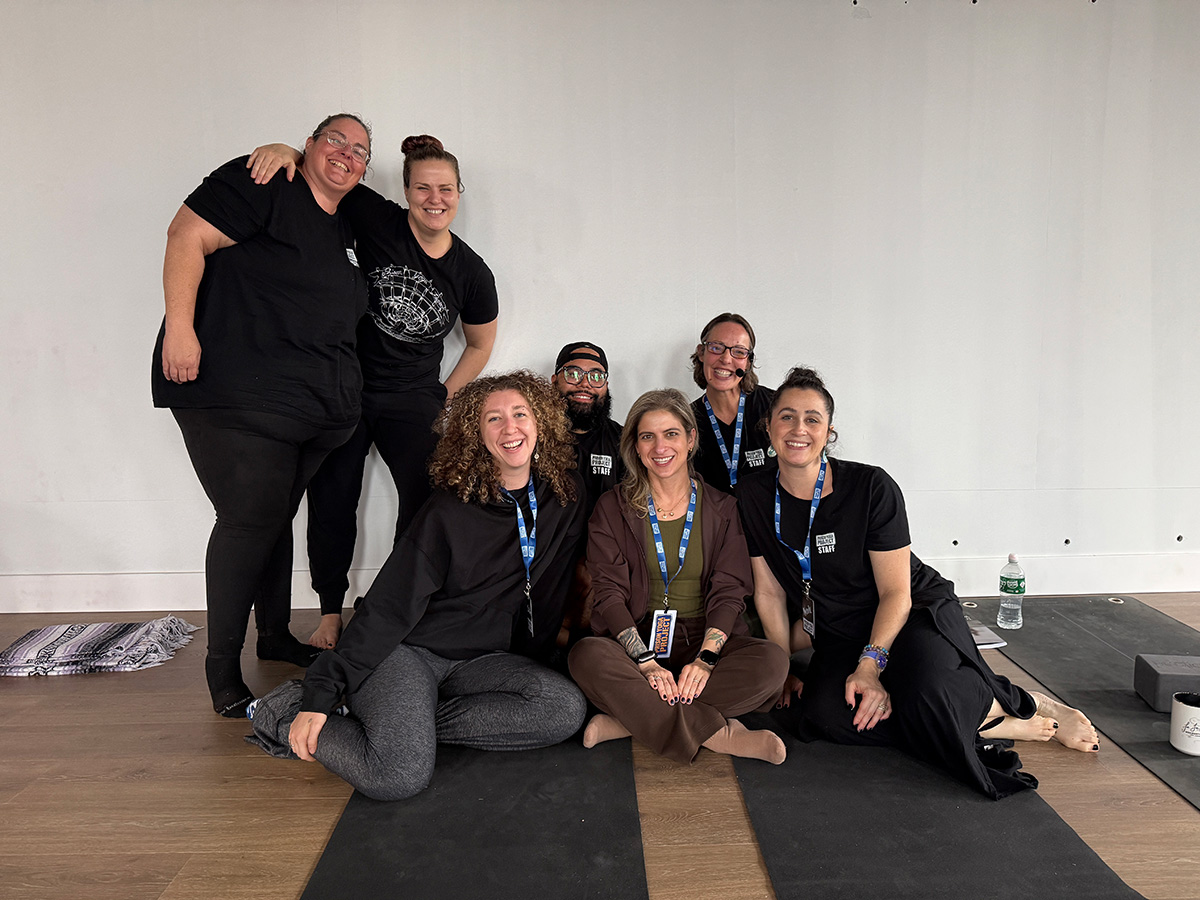
PYP’s Staff and Training Team
From left to right in the photo:
Nicole B. had moved into a full-time role with PYP just days before the training. Nicole drew from her own experience of incarceration to answer trainee questions and, in her role as our Facilitator Onboarding Coordinator, shared what she looks for when interviewing prospective PYP facilitators. She also ventured out on her first train ride for our community, and we could not be more grateful!
Betsie, our Operations Manager, facilitates weekly classes at Pendleton Correctional Facility in Indiana. She shared about recently completing a 200-hour Yoga Teacher Training with men in a maximum-security unit, along with some very sweet stories about how her children have come to understand and support the work she does inside.
Lo, our Community Engagement Manager, is another new full-time member of our team. She spent much of the weekend behind the camera capturing the training, but she is also a PYP youth facilitator and brought valuable insight into what it means to work with teenagers in system-impacted settings.
Alejandro, our Yoga Teacher Training Teaching Assistant, brought both deep knowledge and powerful lived experience to the weekend. He spoke candidly about his own experience of incarceration and what yoga can mean to someone living inside. Every time Alejandro spoke, the rest of us quietly hoped we did not have to follow him. His ability to connect the principles we teach to his own life brought a depth to the weekend that simply cannot be replicated in a training manual. We are thrilled that he will be joining us again for our October and November trainings.
Daria, one of our wonderful PYP Board members, joined us on Sunday. It was our first time meeting in person! Daria is also a PYP facilitator and works with young people in New Jersey, so it was especially meaningful to have her learning and practicing alongside us.
And then there is Jen, our Training Director, who developed the immersion and authored the new sequencing guide at the center of this next chapter of our training.
Jen led the weekend with compassion, thoughtfulness, and years of experience preparing people to bring these practices into correctional settings. There was also a beautiful full-circle connection in having Nicole B. there alongside her. While incarcerated, Nicole was one of the people who advocated for Jen to teach Yoga Teacher Training inside.
Not pictured was Georgia, our Mentor for Community Justice System Liaisons and Facilitators, who also attended the training and brings years of experience teaching yoga inside.
And then there was me.
I had the privilege of looking around the room at this talented, caring team, the incredible community of trainees who had chosen to spend their weekend with us, and the studio that welcomed and supported us, and feeling an immense amount of pride.
Not simply because we had successfully hosted a training.
Because it felt like the beginning of a new chapter for PYP.
More Ways to Carry This Work Forward
Brooklyn was our first stop, but it will not be our last.
Next, we are heading to Longmont, Colorado, October 23–25, followed by Oakland, California, November 13–15.
We would love to have you in the room with us.
But we also know that not everyone can attend an in-person training. That is one reason we are so excited to make Trauma-Informed Yoga: A Facilitator’s Guide to Sequencing, Cueing, and Adaptive Practice available to everyone.
The guide was created to be used. To be written in. To support planning. To offer ideas when you are unsure what to teach. To help you think more intentionally about language, choice, adaptation, and sequencing. And ultimately, to help more people offer trauma-informed yoga practices thoughtfully and responsibly in the communities they serve.
Nearly 50 people began working with it together in Brooklyn.
Now, we are excited to share it with you.
[PURCHASE TRAUMA-INFORMED YOGA: A FACILITATOR’S GUIDE TO SEQUENCING, CUEING, AND ADAPTIVE PRACTICE]
Seven years was a long time to wait to gather like this again.
But we are not simply returning to what we did before. We are finding new ways to share what PYP has learned, equip others to carry this work forward, and bring these practices into more communities than we could ever reach alone.
And we are just getting started.